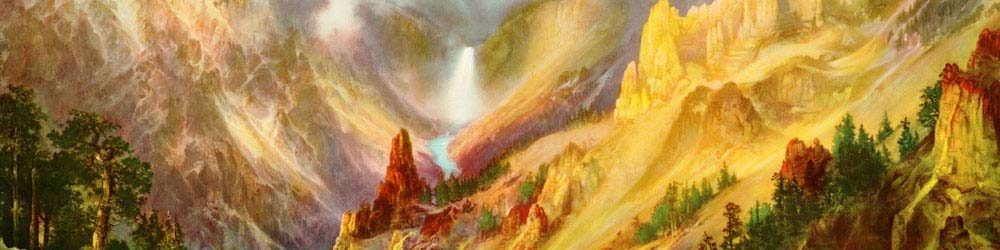
Thomas “Yellowstone” Moran and Yellowstone National Park
by Jack Davis

Yellowstone National Park would not have been established by Congress without the artwork of Thomas Moran (1837-1926). Moran was a member of the Hayden Geological Survey of 1871. His assignment was to illustrate landscapes and geologic features through his artwork. William Henry Jackson (1843-1942) was a pioneer photographer hired by the survey to document the expedition’s journey through his photography. Moran and Jackson worked closely together throughout the trip and became personal friends.
Moran relied on his artistic liberty, or license, to create his images. Moran was asking the viewer to not just see, but also to feel, without distorting an accurate representation of the image. Jackson’s photos were photographic documents that reproduced accurate detail. The albumen photos he produced were created by a wet-plate collodion process with a sepia tone finish. Congress established Yellowstone as the first national park in the world based primarily on Moran’s artwork and Jackson’s photographs.
Thomas Moran made at least 20 field sketches and 9 watercolor paintings of more than 30 sites in Yellowstone during the 40-day expedition of the Geological Survey of 1871. Moran sketched, and Jackson photographed, many of the most compelling features and views during that period of what would become Yellowstone National Park. Ferdinand Vandeveer Hayden (1829-1887) officially concluded his field operations on October 2, 1871, at Fort Bridger in southwestern Wyoming. Moran’s field sketches and watercolor paintings and Jackson’s wet-plate albumen photographs were presented to Congress that fall. Moran’s artwork from the 1871 expedition made a lasting impression with members of Congress. Congress passed the legislation creating Yellowstone National Park just six months after Hayden and his crew completed the expedition. It is useful to examine the life and work of Thomas Moran and William Henry Jackson to appreciate their significance in establishing our first national park.
Thomas Moran’s family emigrated from Bolton, Lancashire, England, and settled in Kensington, PA, a suburb of Philadelphia, in 1844. Thomas apprenticed as a wood engraver, which he found to be tedious. He spent his free time working on his own watercolors. In 1970 Moran was hired by Scribner’s Monthly as a designer. His first job was to design an article submitted by Nathaniel Langford on the 1870 Washburn-Langford-Doane Expedition to the Yellowstone region of northwest Wyoming. Moran designed 14 wood engravings illustrating the wonders and curiosities the expedition encountered in their journey. He was captivated by the story and pined to go there himself one day.
Ferdinand Hayden saw Moran’s designs for Scribner’s and was impressed with the quality of his work. Hayden was preparing for the Geological Survey of the Territories to explore the Upper Yellowstone River region for the upcoming 1871 season. Hayden invited Moran to join the expedition if he could raise funds to cover his expenses. Moran approached Jay Cooke (1821-1905), an investment banker in Philadelphia, to ask for financial assistance. Cooke offered to pay $5,000 toward Moran’s expenses in exchange for the use of Moran’s images in the future. Moran allegedly pledged to produce 12 watercolors of Yellowstone for Cooke. Cooke was in the process of founding a transcontinental railroad from Chicago and Duluth on the Great Lakes to the Pacific and wanted images along the proposed route to promote the new Northern Pacific Railroad (NPRR). Thanks to a letter of support from Cooke’s office manager, A. B. Nettleton, Moran joined the U. S. Geological Survey’s scientific corps as its residence artist. Scribner’s Monthly also contributed toward Moran’s expenses in exchange for the right to publish his images in the magazine. [1]
William Henry Jackson was born in Keeseville, NY. He learned the art of photography and did retouching for photographic studios. Jackson served in the American Civil War for nine months and headed west in 1866. He boarded a Union Pacific Railroad train in 1867 and traveled until it reached the end of the line at that time. He opened a photography studio in Omaha, NE, with his brother and began photographing Native Americans and scenes from the route of the Union Pacific Railroad. Ferdinand Hayden met Jackson in his studio in Omaha and asked him to join the Geological Survey in 1870. Jackson also got an invitation to be a member of the Hayden Geological Survey of 1871. He met Thomas Moran and the two worked closely together to document the Yellowstone region.
Jackson’s photographs recorded the landscape and geologic features along the survey route. Jackson used a wet-plate albumen camera that exposed photographic images on glass negatives. This wet-plate process produced sepia-tone prints on paper coated with albumen egg white. The printing process required a portable darkroom for field work, as the plate had to be sensitized and developed on-site. This was a very labor-intensive process. Wet-plate photography, also known as collodion process, was replaced by the dry-plate process invented by George Eastman in 1878. Kodak cameras transformed photography by making it possible for amateur photographers to make their own pictures.
Jackson’s photographs provided visual confirmation of the scenery and terrain the survey traveled through. The photos proved that the landscape and geologic features were real. Stories and accounts of the region were thought to be rumors or gossip. Folk tales of steam and water shooting out of the ground were not believed. Jackson’s photographs confirmed that these reports were true, and that they really did exist.
One drawback of albumen photographs was they were sepia-toned and did not project any color despite being authentic photographic records. The sketches and paintings Moran created were composed of watercolors and gouache. These were vibrant, creative works of art with a widespread gamut of colors. Moran’s illustrations were not the precise, accurate reproductions with fine detail like Jackson’s photographs. His colorful sketches and paintings required viewers to use their imaginations to interpret the pictures. Moran’s imaginative artwork was a juxtaposition to Jackson’s sepia-toned photographs when the viewer compared images of similar locations and geographic features.
The paintings produced by Moran introduced an emotional aspect to the decision-making process of the members of Congress when they were considering making Yellowstone a national park. Moran’s creative paintings and sketches were enchanting and mystical in nature. The albumen photographs produced by William Henry Jackson were sepia-toned pictures that while accurate reproductions, did not have the visual attraction of Moran’s artwork. Jackson’s photographs were very important to the success of the survey, but they did not evoke the emotional response that Moran’s artwork produced.


The difference between Jackson’s albumen photograph and Moran’s watercolor painting can be seen in “The Towers of Tower Falls, Yellowstone.” Moran’s painting is directly based on Jackson’s photo. Notice the top of the spire to the right in the photo. Moran includes this detail in his painting. The rays of the sun lend a spiritual aspect to the painting. The dissimilarity between the two images is obvious. This quote appears in The Art Journal, February 1879, “Moran’s ability to extrapolate the signature aspects and atmosphere of a specific place and then arrange those features in compositions that conveyed that direct experience, lifted his paintings beyond topography. Despite their clear sense of place, Moran’s subjects are never minutely detailed. His brush strokes carry painterly weight yet articulate nuances of form and structure born of acute observation and an understanding of basic geology and botany. Visitors to the sites made famous by his paintings struggled and failed to achieve the exact view, only then realizing how liberally the artist had compressed or expanded the scene in his works. That talent for conveying the spirit of a place served Moran well in Yellowstone, as he sought to render unique geological forms in a manner his audience would find authentic yet familiar.” [2]
Jay Cooke wanted to build a railroad spur line into Yellowstone through the Lamar Valley to Cooke City, which was named after him. He also pursued developing a series of luxury hotels near the main tourist attractions in the park. However, Cooke’s speculative investments in funding the NPRR failed, and the railroad was forced to declare bankruptcy on September 18, 1873. This action resulted in the “Panic of 1873.” The “Panic” triggered an economic depression in North America and Europe. This was known as the “Great Depression” in the United States at that time.
Work on the NPRR was terminated and did not fully resume until 1879, seven years after Yellowstone National Park was established. The NPRR reached Livingston, MT, in the fall of 1882 and extended a spur line to Cinnabar, MT, six miles north of the park border in 1883. The attempt by Cooke and the NPRR to build a spur line through Lamar Valley to Cooke City was withdrawn because of public sentiment against the proposed project. The interruption of construction of the NPRR from 1873-1879 gave the public time to embrace the notion of a national park for the “Benefit and Enjoyment of the People,” and to oppose large-scale commercial development in the park. The “Panic of 1873” turned out to be a blessing in disguise for the park. Hayden and businessman Nathanial Langford (1832-1911), a member of the 1870 Washburn-Langford-Doane Expedition, lobbied to prevent Yellowstone from being developed and exploited. These efforts could not have happened any sooner. Matthew McGuirk filed a claim for 160 acres where Mammoth Hot Springs runs into the Gardner River with plans to develop a commercial “medicinal spring” in early March of 1872. This tract of land had just been withdrawn from the public domain on March 1, 1872, when President Ulysses Grant signed the Yellowstone Park Bill into law. [3]
The NPRR used Moran’s artwork to promote passenger service on its line. The circa 1883 brochure titled “Romance of Wonderland” shows a reproduction of Moran’s watercolor painting of the “The Towers of Tower Falls, Yellowstone.” The railroad also produced a full-size travel poster, circa 1935, of Moran’s painting of the “Grand Canyon of the Yellowstone.” It is very likely that Yellowstone National Park would not have been established without the financial backing of Jay Cooke to help sponsor Thomas Moran’s participation with the Hayden Survey of 1871.
Thomas Moran was a one of the Hudson River painters. These painters were depicting the way the nation was developing after the Civil War. They had a strong voice in land politics and were a cause for the conservation movement. Moran belonged to the Rocky Mountain School of landscape painters because of all the Western landscapes made by this group, including Albert Bierstadt (1830-1902) and Thomas Hill (1829-1908). He traveled to England with his brother in 1862 to study the works of J. M. W. (Joseph Mallord William) Turner (1775-1851) at the Natural Gallery in London. Moran was profoundly influenced by the British artist and adapted Turner’s sublime style, characterized by dramatic light, vibrant color, and atmospheric effects, to capture the America West. [4] Moran also embraced many of Turner’s techniques to transform western landscapes into romanticized, awe-inspiring scenes of natural grandeur by focusing on atmospheric, luminous, and often ephemeral light. His paintings evoke qualities of the sublime through their expressive depictions of nature. [5]
Moran adopted a brighter, more vibrant color palette, particularly in his rendering of sunlight and sky, to create “Turneresque” scenes of the American West. He was a plein air artist who sketched on location, capturing the essence of nature, and scenery directly from life rather than in a studio. His final works were not meant to be photographic, but rather idealized, emotional interpretations. Turner’s interest in dramatic natural phenomena was echoed in Moran’s painting of the Grand Canyon of the Yellowstone. This painting earned Moran recognition as the “American Turner,” focusing more on the emotional, atmospheric impact of the scene rather than correct topographical details. Of all the artists influenced by Turner, Thomas Moran was perhaps the most technically accomplished.
Moran and Jackson used a similar technique in their images. They both inserted people for perspective. This was a tactic often applied by the Hudson River School artists. A person in a landscape or next to an object provides a sense of scale. It also gives a sense of narrative, telling a story about the environment. Images depicting people are perceived as higher in empathy, making them more compelling than inanimate objects. Viewers tend to follow the gaze of the person in the image, which can lead the eye to other important elements in the frame. Adding figures to landscape paintings enhances scale, narrative, and emotional depth by providing a focal point. A painter will position figures to create a narrative, such as a walking figure to suggest movement, or to act as an anchor that draws the viewer into the scene, turning a static vista into a lived experience. This technique makes landscapes believable and adds emotional depth, scale, and story. A figure against a massive mountain emphasizes grandeur. [6] That effect can be seen in Moran’s watercolor “Hot Springs of Gardiner’s River.”


Moran made field sketches and paintings of more than 30 sites in Yellowstone during the 40-day expedition. The survey party spent 16 days inside what would become the Park boundaries. During that period Thomas Moran sketched, and William Henry Jackson photographed, many of the most compelling features of what was to become Yellowstone National Park. Moran produced nine watercolor paintings that derived from his excursion to Yellowstone. These watercolors were later reproduced as chromolithographic prints by Boston-based Louis Prang (1824-1909) for the 1876 Centennial International Exhibition in Philadelphia. Eight of the paintings were from inside the park and one was north of the park. The view outside the park was the Absaroka Mountains as seen from Fort Ellis. These nine Yellowstone-related chromos were issued in a portfolio with six other chromos of other western scenes. This portfolio by Prang is considered to be the highest quality American chromolithographs ever produced. The Times of London declared that Prang’s Yellowstone portfolio contained some of the finest examples of chromolithography produced anywhere. [7]

Moran’s sketches and paintings from the 1871 expedition made a lasting impression with members of Congress. Congress passed the legislation creating Yellowstone National Park just six months after Hayden and his crew completed the expedition. Hayden and businessman Nathanial Langford, a member of the 1870 Washburn-Langford-Doane Expedition, lobbied to prevent Yellowstone from being developed and exploited. These efforts could not have happened any sooner. In early March of 1872, entrepreneur Matthew McGuirk filed a claim for 160 acres where Mammoth Hot Springs runs into the Gardner River with plans to develop a commercial “medicinal springs.” This land had just been withdrawn from the public domain when President Ulysses Grant signed the Yellowstone Park Bill into law on March 1, 1872. [8]
It is said that when Thomas Moran first gazed upon the canyon, now known as the Grand Canyon of the Yellowstone, he remarked that its beautiful colors “were beyond the reach of human art.” [9] When Moran returned to the east in the fall of 1871, he immediately set to work on a massive painting, Grand Canyon of the Yellowstone, measuring 7 by 12 feet. [10] He was still hard at work when President Grant signed the bill establishing Yellowstone as America’s first national park. Congress demonstrated their gratitude for Moran’s work when they purchased his completed painting for $10,000. [11] This was the most expensive painting to ever sell at that time. Thomas Moran became so synonymous with Yellowstone that he took to signing his painting “TYM” for “Thomas Yellowstone Moran.”

It is likely that the National Park Service would not have been established without the participation and contributions of Thomas Moran and William Henry Jackson. Congress established Yellowstone National Park on March 1, 1872. This decision was primarily based on Moran’s paintings and Jackson’s photographs. Congress would probably not have been persuaded to act without the primary source material of Moran’s artwork and Jackson’s photos. They were critical to the decision-making process.
Yellowstone was established by Congress for the “Benefit and Enjoyment of the People.” Yosemite and Sequoia were created in 1890, 18 years later. They were followed by Mount Rainier in 1899 and Crater Lake in 1902. Devils Tower and Grand Canyon were established as National Monuments in 1906 by Theodore Roosevelt. Glacier, Rocky Mountain and Lassen National Parks followed. These were the last national parks established before WWI. The National Park Service was established on August 25, 1916. That ushered in a new era for national parks and monuments in America. The 433 units the National Park Service currently manages are the consequence of the action taken by Congress on March 1, 1872.
What would have happened to the national park sentiment in America if Yellowstone had not been established when it was? Would the conservation movement in America have been as influential going forward? It is impossible to know the answers to these questions. It is easy to imagine that the national park system in America, and around the world, would not include many of the locations that currently exist. Cultural and heritage sites such as Mesa Verde National Park would have been diminished or destroyed without supervision and management by the National Park Service.
Yellowstone National Park is a special place on many different levels. Thomas Moran’s artwork inspired Congress to establish Yellowstone as the first national park in the world. Yellowstone, and the National Park Service, have inspired other nations to establish their own national parks. We owe a tremendous debt to the efforts of artists and photographers who continue to produce images of national parks and monuments for posterity. Thomas Moran’s artwork and William Henry Jackson’s photographs for the Hayden Geological Survey of 1871 are guiding lights that continues to inspire us 155 years later. Where would we be today without them?

Leave a Reply