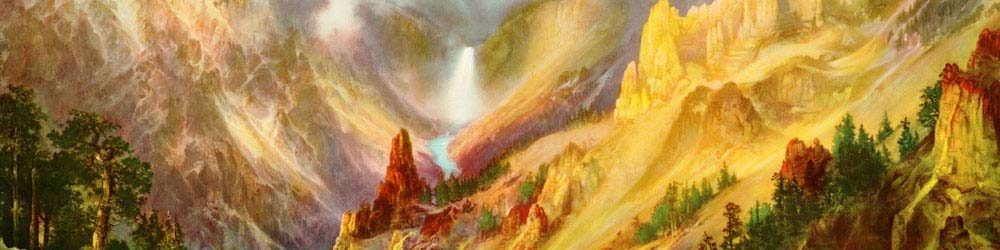
Northern Pacific Railroad and Yellowstone National Park
by Jack Davis
Yellowstone National Park (YNP) would probably not have become a national park without the participation and support of the Northern Pacific Railroad (NPRR). Below is the NPRR Monad logo. The Chief Engineer of the NPRR visited the Korean exhibit at the 1893 World’s Fair in Chicago. He saw the Korean flag and was impressed by the simple, but striking design. He was searching for a trademark for the railroad and adopted the design for that purpose. The two principals in the design represent Yang and Yin. They can also be described as male and female, darkness and light, positive and negative, Earth and Heaven, and various other opposite mediums. The NPRR Monad logo is easily recognizable and can be found on publications, ephemera, train cars, uniforms and other properties of the company.

Jay Cooke (1821-1905) was an American financier who was proclaimed the first investment banker in the United States. He was born in Sandusky, OH, in 1821 and relocated to Philadelphia in 1838. Cooke entered the banking business in Philadelphia and opened the private banking house of Jay Cooke & Company in 1861, just before the start of the American Civil War. Cooke was hired by the government as a special agent to sell $500 million in bonds to support the Union Army. He was offered a sales commission of .5 percent. He set up a nationwide sales campaign to sell the bonds, appointing about 2,500 sub-agents who traveled through every northern and western state. Cooke sold the $500 million in bonds in a short time and then sold another $11 million bonds soon afterwards. He was accused of corruption by some members of Congress, but an investigation was never initiated.
Cooke became acquainted with Dr. Ferdinand V. Hayden, who also lived in Philadelphia. Hayden was preparing to lead a government sponsored expedition to explore the upper Yellowstone River. Cooke visited Duluth, MN, in 1868. He saw Duluth as a vital link for a railroad connecting the Great Lakes and the Pacific. The railroad he proposed was the Northern Pacific (NPRR). Cooke understood that the Hayden Geological Survey would be essential in promoting this railroad. He paid $5,000 to defray the cost of two additional members of the expedition, the photographer William Henry Jackson and the artist Thomas Moran. Cooke was convinced that images of the territory could be useful in promoting a railroad through that region.

Cooke’s investments became over extended and were the principal cause of the Panic of 1873. This economic depression lasted until 1879. Construction of the NPRR came to a stop and did not fully resume until 1879. Yellowstone National Park (YNP) was established by Congress on March 1, 1872, after Hayden’s expedition return to Philadelphia. Jackson’s photos and Moran’s artwork were consequential in Congress’s decision to establish Yellowstone National Park, the first national park in the world. It is likely that the Park would not have been established without the support of Jay Cooke and his willingness to subsidize Jackson and Moran’s trip. The NPRR did benefit by using Moran’s images for advertising. The brochure cover below on the left is an illustration of a Moran watercolor of the Spires at Tower Fall in YNP.

The poster below of a Moran painting was published by the NPRR circa 1935. This is one in a series of 15 travel posters by the NPRR ca. 1929–1938. One reason this series is significant is because it was produced in America. Most of the most collectible travel posters were produced in Europe. The NPRR posters competed in quality with the European posters. The Golden Age of Illustration was a period dating circa 1885 through 1935. Artists were commissioned by publishers to create original works for illustration. The formats included trade cards, postcards, posters, brochures and magazines. Advertising became mush more popular with the advent of color printing. I will discuss this and the printing process of chromolithography in detail in a separate arti

The NPRR was the main driving force behind YNP from the early 1870s until WWI. The National Park Service (NPS) was established in 1916. This was the beginning of the end of the dominance the railroads enjoyed with national parks. The NPS authorized motorization transportation in YNP on August 1, 1915. Horse-drawn transportation was discontinued in national parks after the 1916 season and tourism increased in YNP almost every year after that. Tourists could now travel to and through national parks from the comfort of automobiles and buses. Railroads continued to service YNP, but it was just a matter of time before they discontinued passenger service in the 1960s. Below is an early map showing the NPRR route from the Great Lakes to the Pacific.

Yellowstone was located about halfway between the NPRR termini of St. Paul, MN, and Tacoma, WA. This was a convenient tourist destination in both directions. The NPRR also promoted Rainier National Park, located near the western terminus in Tacoma. The railroad produced travel posters of both national parks and other tourist destinations along the route. The Golden Age of Illustration was the 50-year span between 1885-1935. The NPRR commissioned a number of different artists to produce paintings and illustrations of views along the route from the Great Lakes to the Pacific. The poster below at left is by Sydney Lawrence. Lawrence also produced “Alaska – Off to the Potlatch” in this series. The poster below at right by the artist Gustav Krollmann.

The NPRR published a series of 15 travel posters circa 1929 through the 1930s. This series includes some of the most iconic and collectible American travel posters ever created. These NPRR posters rival many of the European travel posters from the same time. These posters are very desirable among collectors and are becoming harder to find, especially in very good to excellent condition. We collected and sold posters in this series for many years. The three posters below are all by the same artist, Gustav Krollmann. Krollmann produced 5 of the 15 posters in this series, including Mt. St. Helens. He was the most prolific NPRR artists, illustrating a number of brochures for the railroad during the Golden Age of Illustration.

The NPRR also commissioned and produced poster-style artwork for brochure covers. Poster-style is a term describing an image having a similar perspective as a full-size poster, but in a smaller format. The same is true for a poster-style postcard. A paper dealer once told me that looking at a poster-style brochure cover or postcard was like looking at a full-size poster at a distance. The ratio of most full-size posters from the late 19th and early 20th centuries is 2:3 or 3:4. The dimension of a full-size NPRR poster in this series is 30×40 or 40×30 inches. This is similar to the ratios of many of the railroad brochure covers. Poster-style images from the Golden Age of Illustration are very popular and collectible. These smaller-format images are also more affordable and easier to curate.


The NPRR produced a series of brochures with the name of “Wonderland.” The name “Wonderland” referred to the entire route between St. Paul, MN, and Tacoma, WA. YNP was referred to as “Wonderland” as early as 1871, before it was established as a national park. The earliest “Wonderland” brochure published by the NPRR is ©1882. The title of this brochure is “A Romance in Wonderland.” The second brochure in this series was titled “Alice in the New Wonderland: Yellowstone National Park.” This brochure is ©1883. The “Wonderland” brochures were issued almost every year from 1882 through 1937, except for WWI. The name “Wonderland” shows up in many of the NPRR ads from the late 19th and early 20th centuries. Below is an assortment of NPRR ads promoting ‘Wonderland.”


The NPRR also produced other YNP posters and poster-style brochure covers. I am going to include one more poster in this article and will revisit this topic in another article as time permits. The last poster I want to discuss is a rare birdseye view of the park from 1904. The artist is Henry Wellge. He is best known for the birdseye views he produced for railroads near the turn of the century. Wellge would ride on trains and illustrate views along the routes. He would find an elevated location to use to visualize the maps he created. One factor that makes this particular birdseye map so unusual is that he visualize this image without the help of an elevated point of view.

This birdseye view of the park was commissioned by the NPRR. It is listed in the 1904 “Wonderland” brochure and in various ads for the price of 35 cents postpaid. It shows up in later ads which indicates that there were copies that were produced that did not sell in 1904 and were available to purchase. This is a rare chromolithographic poster. There are a few reasons we believe this map is so rare. The paper it was printed on is soft and easily soiled. The few copies we have seen have discoloration along one edge. These posters were rolled and put into tubes for shipping. We believe the discoloration is along the edge of the poster that was on the top of the roll when it was inserted into the tube. This poster may be the most collectible NPRR poster that was produced. The soft paper it was printed on was easily soiled and/or soiled and very few of these have survived.
I will post additional articles on posters and poster-style images produced by the NPRR and other railroads as time permits. The NPRR was the driving force behind Yellowstone National Park. It is likely that the park would not have been established without the support of the NPRR. The same can be said about Glacier National Park and the Great Northern Railroad, Grand Canyon and the Santa Fe Railroad, and the Utah parks and the Union Pacific Railroad. Railroads played a vital part in the establishment of many of the national parks and monuments.

Leave a Reply